The Difference Between ADHD Stimulants: Methylphenidate vs. Amphetamine
Share Article
Latest Posts
July 9, 2026
If you or your child has just been diagnosed with ADHD, you’ve probably heard names like Adderall, Ritalin, Vyvanse, and Concerta thrown around — often with strong opinions attached. It can feel overwhelming. The good news: once you understand the basics, the differences between these medications are actually pretty simple.
You don’t need a biology degree to follow this. We’ll start with three tiny “messengers” in your brain, explain what they do using everyday comparisons, and then show you exactly how ADHD stimulants help. Let’s go.
First, meet your brain’s chemical messengers
Your brain is made of billions of cells that need to talk to each other constantly. They don’t touch — there’s a microscopic gap between them. To send a message across that gap, a brain cell squirts out a tiny chemical. Think of these chemicals as text messages between cells. Scientists call them neurotransmitters.
Three of them matter most for this conversation:

Dopamine — the motivation & reward messenger
Dopamine is your brain’s inner hype-coach. It’s the little voice that says “this matters — let’s do it,” and then “nice job!” when you finish. It’s what makes a task feel worth starting and rewarding to complete.
Here’s the key part: in ADHD, the dopamine signal tends to run low and inconsistent. That’s a big reason why someone with ADHD can hyper-focus on something exciting for hours, yet find a boring email almost physically impossible to start. The coach only shows up sometimes.
Norepinephrine — the alertness & focus messenger
If dopamine is the coach, norepinephrine is the spotlight operator. It decides where your attention points and how brightly. When norepinephrine is doing its job, you can shine your mental spotlight on one task and dim everything else — the background chatter, your phone, the itch on your arm.
When it’s low, the spotlight drifts around the room, landing on whatever’s loudest or newest. That’s the distractibility side of ADHD.
Serotonin — the mood & calm messenger
Serotonin is the thermostat for your mood. It keeps things steady, calm, and even — and it also helps shape your sleep, appetite, and overall emotional balance. When it’s well-regulated, you feel level. When it’s off, mood can swing or dip.
Serotonin isn’t the main player in ADHD itself, but it matters here for one important reason we’ll come back to: ADHD stimulants barely touch it. That’s actually part of why they work the way they do.
So what do ADHD stimulants actually do?
Here’s the whole idea in one sentence: stimulant medications increase dopamine and norepinephrine in the focus-and-motivation circuits of the brain — turning up the coach and steadying the spotlight.
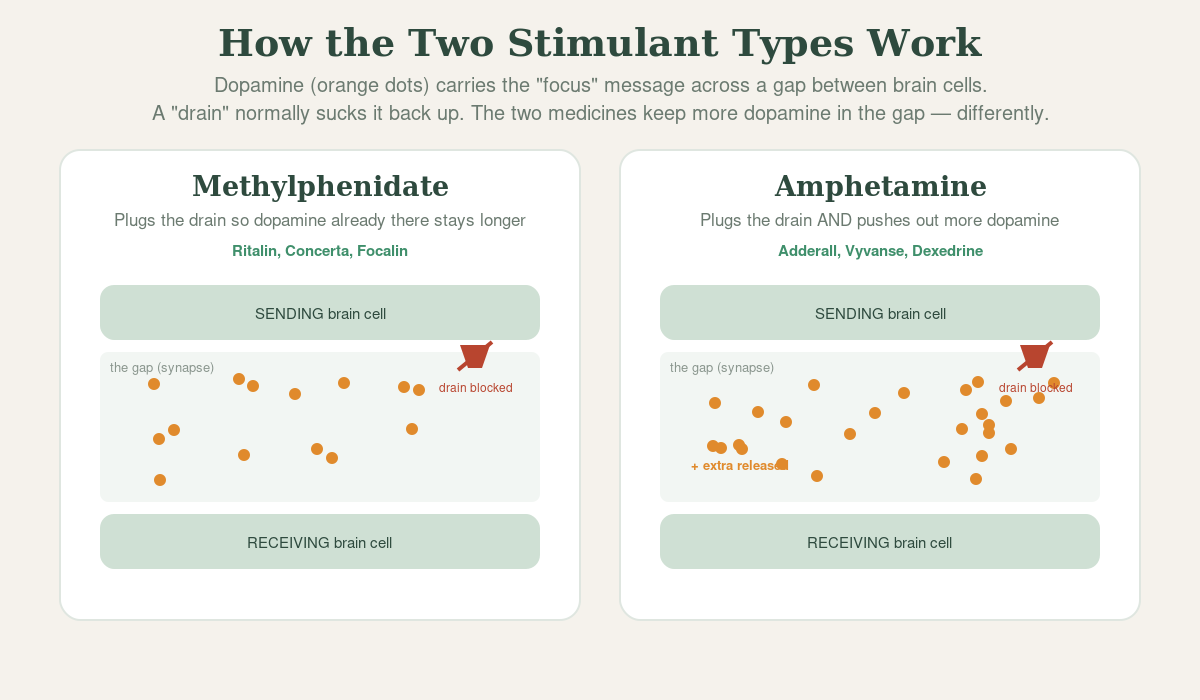
Now picture that gap between two brain cells. The sending cell squirts dopamine (imagine little orange dots) across the gap so the receiving cell gets the “focus” message. Normally, a kind of drain quickly vacuums those dots back up so the signal is short. In ADHD, there often aren’t enough dots to begin with, so the message is weak.
Stimulants keep more dopamine in the gap so the message comes through clearly. The two main families of stimulants just do it in slightly different ways:
Family 1: Methylphenidate — “plug the drain”
Common brand names: Ritalin, Concerta, Focalin, Metadate, Daytrana (patch).
Methylphenidate mainly works by plugging the drain. It blocks the little pump that would normally suck dopamine back up, so the dopamine that’s already there hangs around in the gap longer. The message gets more time to land. Scientists call this “blocking reuptake.”
Analogy: imagine a sink slowly filling. Methylphenidate puts a stopper in the drain, so the water level you already have rises and stays up.
Family 2: Amphetamine — “plug the drain AND turn on the faucet”
Common brand names: Adderall, Vyvanse, Dexedrine, Adzenys.
Amphetamine does the same drain-plugging trick — and then some. It also nudges the sending cell to release more dopamine in the first place. So you get more dots in the gap and they stay longer. Back to the sink: amphetamine plugs the drain and turns up the faucet.
This is the single most important biological difference between the two families: methylphenidate mostly keeps existing dopamine around; amphetamine keeps it around and pumps out extra.
So which one is “better”?
Neither, exactly — and that’s not a cop-out. Both families are considered first-line, front-of-the-line treatments for ADHD, and they’re similarly effective for most people. The largest head-to-head analysis of ADHD medications (Cortese and colleagues, published in The Lancet Psychiatry in 2018, pooling 133 trials) found a helpful pattern:
- For children and teens: methylphenidate tends to be the best-supported first choice.
- For adults: amphetamine-based medications tend to have the edge.
“Tend to” is doing real work in those sentences. These are averages across thousands of people — not a rule about you. Plenty of adults do beautifully on methylphenidate, and plenty of kids do best on an amphetamine. Two people with the same diagnosis can respond completely differently to the same pill, which is why finding the right medication is a collaborative, trial-and-adjust process rather than a one-shot prescription.
A quick side-by-side
| Methylphenidate | Amphetamine | |
|---|---|---|
| Common brands | Ritalin, Concerta, Focalin | Adderall, Vyvanse, Dexedrine |
| Main move | Plugs the drain (keeps dopamine around longer) | Plugs the drain and releases more dopamine |
| Often favored for | Children & teens | Adults |
| Effectiveness | Similar for most people | Similar for most people |
What about side effects?
Because both families turn up the same messengers, they share a similar set of common, usually manageable side effects. The ones to know about include reduced appetite, trouble sleeping (especially if taken too late in the day), a modest bump in heart rate and blood pressure, dry mouth, headache, and sometimes feeling jittery or more irritable as the dose wears off in the evening.
Most of these are dose-related and improve with small adjustments — a different dose, a different release formula (short-acting vs. all-day), or a different time of day. This is exactly what follow-up visits are for.
Why serotonin matters here (even though stimulants barely touch it)
Remember serotonin, the mood thermostat? ADHD stimulants work almost entirely on dopamine and norepinephrine and leave serotonin mostly alone. That’s why a stimulant is not an antidepressant, and why treating ADHD doesn’t automatically fix anxiety or depression — those often involve serotonin and other systems.
It also cuts the other way: if someone has ADHD and anxiety or depression, the full picture matters. Sometimes treating the ADHD helps everything settle; sometimes a second, different approach is needed. Mapping that out carefully is a core part of a thorough evaluation.
The bottom line
ADHD stimulants boost dopamine (motivation and reward) and norepinephrine (alertness and focus) so your brain’s coach and spotlight can do their jobs. The two families get there slightly differently — methylphenidate keeps existing dopamine around, while amphetamine keeps it around and releases more. Both are effective and safe when prescribed and monitored carefully, and the “right” one is simply the one that fits your brain, your history, and your goals.
Finding that fit is a partnership. At Limitless Psychiatry, we start with a comprehensive evaluation, choose a starting medication together, and adjust based on how you actually feel — not a chart. If you’re weighing your options, schedule a free 15-minute consultation and we’ll talk it through.
Sources
- Cortese S, et al. “Comparative efficacy and tolerability of medications for ADHD in children, adolescents, and adults: a systematic review and network meta-analysis.” The Lancet Psychiatry, 2018. Read the study
- U.S. Food & Drug Administration. “FDA updating warnings to improve safe use of prescription stimulants used to treat ADHD.” FDA Drug Safety Communication
- Centers for Disease Control and Prevention. “ADHD in Adults.” CDC NCHS Data Brief
- Faraone SV. “The pharmacology of amphetamine and methylphenidate.” Neuroscience & Biobehavioral Reviews, 2018.
Medical disclaimer: This article is for general education and is not medical advice. Stimulant medications are controlled substances that require evaluation, a prescription, and ongoing monitoring by a qualified clinician. Do not start, stop, or change any medication without speaking to your prescriber.
The information provided on this website is for general informational purposes only and does not constitute medical advice.
Stay Connected with Us